Choosing between a dental clinic vs private dentist can feel confusing when you need dental care. These two types of dental offices work differently and offer unique experiences for patients.
The main difference is that dental clinics are usually larger facilities with multiple dentists and specialists, while private practices are owned and run by individual dentists or small groups who focus on building personal relationships with their patients.
Understanding these differences helps you pick the right place for your dental needs. Clinics often cost less and give you quick access to specialists under one roof. Private practices typically offer more personalized care, with you seeing the same dentist at each visit.
Your choice depends on what matters most to you, whether that’s lower prices, specialist access, or a close relationship with your dentist.
Both options provide quality dental care, but they work in different ways that affect your experience. Knowing what to expect from each type of office helps you make a smart choice before booking your appointment.
Key Takeaways
- Dental clinics offer lower costs and multiple specialists, while private practices focus on personalized care and long-term patient relationships
- Private practices give you more one-on-one time with your dentist, but clinics provide faster access to specialized treatments
- Your best choice depends on your budget, whether you need specialists, and how important a personal connection with your dentist is to you
Table of Content
- Dental Clinics and Private Practices: Key Definitions
- Core Differences Between Dental Clinics and Private Practices
- Range of Dental Services Offered
- Affordability and Payment Options
- Key Factors to Consider Before Booking
- Frequently Asked Questions
Dental Clinics and Private Practices: Key Definitions
Dental clinics and private practices operate under different ownership structures and serve patients in distinct ways. Each setting offers unique benefits based on size, staffing, and how care is delivered.
What Is a Dental Clinic?
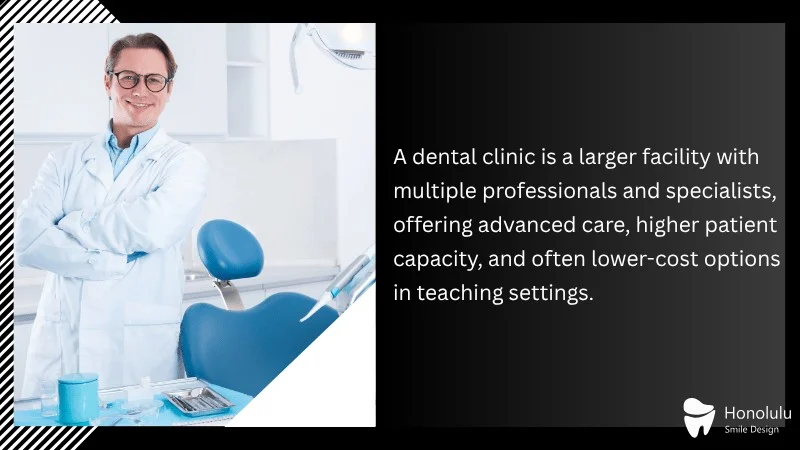
A dental clinic is typically a larger facility that houses multiple dental professionals under one roof. These clinics often include specialists such as orthodontists, oral surgeons, and periodontists working together.
Dental clinics can be part of healthcare systems, teaching hospitals, or independent group practices. Some clinics operate as Dental Support Organizations (DSOs), in which corporations or private equity firms own the facility and provide business support to dentists.
Dental school clinics offer quality, affordable services as teaching centers where students treat patients under supervision. These educational clinics typically charge 50-70% less than traditional dental offices.
Most dental clinics can handle high patient volumes and feature advanced technology for complex procedures. You’ll often find multiple treatment rooms and extended hours to accommodate more people.
Understanding Private Dental Practice
A private dental practice is owned and operated by individual dentists or small groups of dentists. Your dentist makes all treatment decisions without corporate oversight.
Private practices focus on building long-term relationships with their patients. The dentist is aware of your health history and creates treatment plans tailored to your specific needs.
These offices typically see fewer patients per day compared to larger clinics. This lower volume means you often get longer appointments and more personal attention during visits.
The atmosphere in a private dental office tends to be more relaxed and comfortable. You’ll usually see the same dentist at each visit, which helps build trust over time.
Types of Dental Settings
Beyond traditional private practices and clinics, several other dental settings serve different patient needs:
Corporate Dental Chains operate multiple locations under one brand name. These are owned by corporations focused on efficiency and treating high patient volumes.
Low-Cost Dental Centers provide affordable care in underserved areas. They often have board-certified specialists on staff and accept walk-in patients for emergencies.
Group Practices involve multiple dentists sharing space and resources while maintaining some independence. Each dentist may have their own patients but share equipment and staff.
Specialty Clinics focus on specific areas like orthodontics or oral surgery. You’ll visit these locations when your regular dentist refers you for specialized treatment.
Looking for a trusted dentist in Honolulu, HI? Book your appointment today and experience high-quality dental care at Honolulu Smile Design.

Core Differences Between Dental Clinics and Private Practices
The way dental offices are set up affects everything from who owns the practice to how much time you spend with your dentist. Corporate dental offices operate differently than smaller private offices in terms of structure, feel, and how consistently you see the same provider.
Ownership and Management Structure
Corporate dentistry is owned by larger companies, private equity firms, or dental groups. These organizations focus on seeing more patients and running efficiently to make a profit.
A corporate dentist typically follows protocols set by the company rather than making all treatment decisions independently.
Private practice dentists own and run their own offices, either alone or with a small dental group. This means your private dentist has more control over how the practice operates. They can choose which services to offer and how to deliver care without corporate approval.
The ownership structure directly impacts decision-making. Private practices allow dentists more autonomy in creating treatment plans based on what each patient needs rather than following a one-size-fits-all approach.
Atmosphere and Patient Experience
Private dental offices tend to feel more relaxed and personal. You often get more focused attention during your visit, which can help you feel more comfortable. The setting allows for flexible scheduling and treatment plans tailored to your specific needs.
Corporate dental offices are built to handle higher patient volumes. This can create a more clinical atmosphere where efficiency is the priority. You might not see the same dentist at each visit, making it harder to build a relationship with your provider.
The difference shows up in how much time dentists spend with patients. Private practices prioritize not rushing appointments and treating patients like family members rather than focusing purely on volume.
Continuity of Care
One major difference between these settings is whether you see the same dentist each time. In private practices, you typically build a long-term relationship with your private practice dentist. They get to know your dental history and can spot changes over time.
At larger dental centers, you’ll likely go from one dentist to another. This rotation can make it difficult to establish trust or ensure someone familiar with your specific situation is overseeing your care.
Your records transfer between providers, but the personal connection and institutional knowledge aren’t the same.
Continuity matters especially for ongoing treatments or when managing complex dental issues. Having the same provider follow your case from start to finish often leads to better outcomes and a more personalized experience.
Range of Dental Services Offered
The types of services available at dental clinics versus private practices can differ significantly, affecting your treatment options and how you receive care.
Private practices often provide more specialized procedures, while clinics tend to focus on essential and preventive treatments.
General and Preventive Care
Both dental clinics and private practices offer basic preventive services like teeth cleaning, dental examinations, and fillings. You can expect routine care such as fluoride treatments and oral health screenings at either location.
Private practices typically have more flexibility in scheduling preventive appointments and may offer extended hours for your convenience. Many provide comprehensive general dentistry services including dental X-rays and periodontal assessments.
Dental clinics often prioritize preventive care because these services help reduce more costly treatments later. You’ll find that dental clinic consultation rates for basic cleanings and checkups are usually lower than private practice fees.
Clinics may also focus more heavily on pediatric dentistry and education about proper oral hygiene.
Specialties and Advanced Procedures
Private practices generally offer a wider range of advanced dental services compared to clinics. You can often receive cosmetic dentistry procedures like veneers and teeth whitening directly from your dentist without referrals.
Many private practices perform complex treatments including dental implants, root canals, and crown and bridge work.
Research shows that dentists provide different services based on insurance type, with the greatest differences appearing in prosthodontic procedures like dentures and crowns.
Dental clinics may have limited capacity for specialized treatments. You might need referrals to see specialists, such as an orthodontist, periodontist, or oral surgeon.
Some larger dental centers offer multiple specialists under one roof, including orthodontics, endodontics, and periodontics.
Common specialty services by location:
- Private practices: Cosmetic dentistry, dental implants, prosthodontics, restorative dentistry
- Dental clinics: Basic orthodontics referrals, limited oral surgery, emergency extractions
Access to Technology and Equipment
Private practices often invest in newer technologies such as digital X-rays, intraoral cameras, and advanced imaging systems. Your dentist may use these tools to provide more precise diagnoses and treatment planning.
The equipment and setting differ between dental offices and clinics based on funding and patient volume. Private practices typically update technology more frequently to stay competitive and attract patients seeking modern care options.
Dental clinics may have older equipment due to budget constraints. However, university-affiliated clinics sometimes have access to cutting-edge technology used for training purposes. You should ask about available technology when choosing where to receive care.
Handling Dental Emergencies
Private practices and chain dentists handle dental emergencies differently, depending on their structure and staffing. Private practices may accommodate emergency appointments for existing patients during regular hours.
Dental clinics often have systems designed for walk-in dental emergency care. You might face longer wait times, but clinics often accept patients without appointments for urgent issues such as severe tooth pain or broken teeth.
Many private practices have after-hours emergency protocols. Your dentist may provide a phone number for urgent situations or direct you to an emergency dental facility. Clinics typically operate during set hours and redirect true emergencies to hospital emergency rooms.
Our team focuses on building long-term relationships while providing modern treatments and preventive care. Schedule your visit to experience personalized dentistry designed around your needs.
Affordability and Payment Options
Cost often determines where patients seek dental care and which treatments they pursue. Private practices typically charge higher fees than dental clinics, but both settings offer various payment solutions to make care more accessible.

Dental Services Cost Comparison
Private practices generally set their own fees based on overhead costs, location, and the expertise of their dentists. A routine cleaning might cost $75 to $200, while more complex procedures like crowns can range from $800 to $3,000.
Dental clinics, especially community health centers, often use sliding fee scales based on your income.
You might pay $30 for a cleaning if you qualify for reduced rates. Low-cost dental centers offer more affordable rates than traditional private practices, particularly in metropolitan areas.
The dental services cost varies significantly between providers. Getting cost estimates before treatment helps you budget and compare options across different practices.
Insurance and Financing
Most private practices accept major dental insurance plans, though some operate on a fee-for-service model where you pay upfront and submit claims yourself. Insurance-based models offer pre-negotiated rates when dentists are in-network with your plan.
Community clinics frequently accept Medicaid and other government-sponsored insurance. Many practices partner with financing companies like CareCredit to help spread treatment costs over time with monthly payments.
Third-party financing options often include interest-free periods if you pay the balance within 6 to 24 months. This makes expensive procedures more manageable for your budget.
Low-Cost and Community Clinics
Dental schools like Penn Dental Medicine provide supervised care at reduced rates, sometimes 30-60% less than private practices. Students perform treatments under faculty oversight, ensuring quality while keeping costs down.
Community health centers receive federal funding to serve uninsured and low-income patients. These clinics focus on preventive care and basic treatments.
Federally qualified health centers (FQHCs) must accept all patients regardless of ability to pay. They adjust fees based on household income and family size.
Membership and Payment Plans
Some private practices offer dental membership plans as an alternative to traditional insurance. You pay an annual or monthly fee for routine cleanings, exams, and discounts on other services.
These plans typically cost $200-$500 per year and appeal to patients without dental insurance. You get predictable costs without dealing with insurance claim paperwork.
In-house payment plans let you spread treatment costs over several months directly with the practice. These arrangements work well for procedures costing under $2,000 and don’t require credit checks like third-party financing does.
Key Factors to Consider Before Booking
When choosing between a dental clinic and a private practice, consider location, the level of personalization you want, how long you’ll wait for appointments, and the quality standards each option maintains.
Location and Convenience
The location of your dental provider matters more than you might think. You want a dental practice close to your home or work so you don’t miss appointments.
Dental clinics often accept walk-in patients. This makes them helpful if you need care right away. Private practices usually require you to book appointments in advance.
Some clinics are open on evenings and weekends. Private practices might have more limited hours. Think about your work schedule and when you can realistically get dental care.
Personalization and Relationship Building
Private dental practices focus on building long-term relationships with patients. Your dentist learns about your health history and remembers details about your care.
The advantages of private practice include this personalized approach, where you see the same dentist each visit.
Dental clinics, especially those connected to schools, may have you see different providers. Student dentists work under supervision and give thorough care, but you might not build the same ongoing relationship.
If you value knowing your dentist personally, a private practice is a better fit. If you care more about cost and don’t mind seeing different providers, a clinic works fine.
Wait Times and Scheduling
Private practices typically see fewer patients per day. This means shorter wait times in the lobby and more time during your appointment. You’ll get focused attention without feeling rushed.
Dental clinics connected to schools may have longer wait times. Treatments take more time because student dentists work carefully under supervision. Your appointment might last longer than at a private practice.
For urgent care, some clinics offer same-day appointments. Private practices might make you wait several days or weeks for an opening, especially if you’re a new patient.
Quality and Safety Standards

Both dental clinics and private practices must meet the same safety regulations. Your care quality doesn’t drop just because you choose a lower-cost option.
Dental school clinics use current treatment methods and modern technology. Student dentists learn the latest techniques and apply them carefully. Faculty members supervise every procedure to ensure it’s done correctly.
Private practices invest in their own equipment and training. Dentists have full autonomy over treatment decisions. They can customize your care plan without following corporate protocols.
Look for dentists with good reviews and proper credentials, regardless of whether you pick a clinic or private practice.
From routine cleanings and exams to advanced restorative and cosmetic treatments, our team provides dental care designed around your comfort and long-term oral health. Contact us today to book your appointment.
Frequently Asked Questions
Patients often have similar questions when comparing dental clinics and private practices.
Understanding ownership structures, cost differences, location factors, personalization levels, service availability, and dentist qualifications can help you make the best choice for your dental care needs.
What are the main differences between a dental clinic and a private dental practice?
The main difference lies in ownership and how care is delivered. Private practices are owned and operated by individual dentists or small groups, which gives them more control over treatment decisions.
Dental clinics are typically larger facilities that house multiple dental professionals. They may be part of hospitals, schools, government offices, or other public establishments.
Corporate dentistry is owned by larger entities such as corporations or private equity firms. These organizations focus on operational efficiency and seeing a higher volume of patients.
Private practices usually offer a more relaxed atmosphere with personalized attention. Clinics operate in a more clinical manner and handle more patients each day.
How do the costs typically compare when choosing between a dental clinic and a private practitioner?
Dental clinics often charge less for treatments compared to private practices. The price difference doesn’t mean lower-quality care.
Clinics affiliated with educational institutions, like Penn Dental Medicine, offer services at 50%-70% lower cost than private practices. Students provide treatment under the supervision of experienced faculty members.
A routine checkup at a dental clinic might cost $50-$75, while the same service at a private practice could cost $100-$200. Dental cleanings range from $30-$60 at clinics compared to $80-$150 at private offices.
Fillings can cost $50-$100 at clinics versus $150-$300 at private practices. Extractions typically run $75-$150 at clinics and $150-$400 at private offices.
What should I consider when deciding on the location for my dental care?
You should think about convenience and how far you’re willing to travel for appointments. Consider whether you prefer being close to family and friends or if you’re comfortable commuting for treatment.
Dental clinics are often located in areas with limited access to dental services. They serve communities that need affordable care options.
Private practices may be spread throughout different neighborhoods and business districts. You’ll want to choose a location that fits your daily routine and transportation options.
Think about parking availability and public transit access. Emergency visits will be easier if your dental provider is nearby.
Can patients expect different levels of personalized care between a dental clinic and a private practice?
Yes, the level of personalized care typically differs between these settings. Private practices provide more tailored services that meet your unique needs as an individual patient.
Private practice dentists focus on building long-term relationships with their patients. They take time to understand your health history and don’t rush through appointments.
The atmosphere in private practices tends to be more relaxed and intimate. You’ll often see the same dentist at each visit, which helps establish trust.
Dental clinics handle higher patient volumes and may feel more impersonal. You might not see the same practitioner during successive visits, making it harder to build a lasting relationship.
What types of services might be offered at a dental clinic versus a private dental office?
Dental clinics often provide a wider range of services under one roof. They typically have board-certified specialists on staff for oral surgery and orthodontics.
Many clinics accept walk-in patients and offer easy access to emergency care. This makes them convenient when you need immediate attention.
Private practices may focus on general dentistry with fewer specialists available on-site. You might need a referral to see a specialist for complex procedures.
Both settings offer routine services like checkups, cleanings, fillings, and extractions. The main difference is how quickly you can access specialized treatments without being referred elsewhere.
How do the qualifications and experiences of dentists in clinics differ from those in private practice?
Dentists in both settings must meet the same licensing and education requirements. All dentists complete dental school and pass state board examinations before practicing.
Educational dental clinics use student doctors who work under the supervision of experienced faculty members. These students are highly motivated and provide thorough care, though treatments may take longer.
Private practice dentists have complete autonomy in their decision-making. They bring their individual experience and preferred treatment approaches to patient care.
Clinic dentists may have access to the latest research and teaching methods through their affiliation with educational institutions. Private practitioners attend continuing education courses to stay current with dental advances.