Losing most or all the teeth in one arch brings up a question almost every patient asks at the first consultation: do I need an implant under every missing tooth, or can four implants carry the whole arch?
When comparing all-on-4 vs individual implants, the best choice depends on how many teeth need replacing, the condition of your jawbone, and whether you want to preserve healthy natural teeth.
For a full upper or lower arch, All-on-4 is usually the better fit for people missing most or all their teeth who want a fixed bridge without months of bone grafting, while individual implants suit patients who still have healthy teeth worth keeping or who want each tooth replaced and maintained on its own.
The right answer depends on how much bone remains, how many teeth are actually failing, and how you want to care for your new teeth over the next twenty years.
A per-tooth quote and a bundled arch quote can look wildly different on paper, and that gap confuses a lot of patients before they even get to the surgical details.
Key Takeaways
- All-on-4 replaces a full arch with four implants and one fixed bridge, while individual implants restore each tooth separately and cost more per arch when many teeth are missing.
- Jawbone density and the location of bone loss often determine whether angled implants can skip grafting or whether a different plan is safer.
- Same-day teeth are typically temporary, and a mixed approach, such as All-on-4 on one arch with individual implants or implant-supported dentures on the other, is sometimes the most practical answer.
Which Approach Fits a Full Upper or Lower Arch?
All-on-4 uses four dental implants to anchor a full-arch implant bridge, while individual dental implants replace each missing tooth one at a time with its own post and crown.
Both rely on titanium implants fusing to the jawbone, but the number of implants, the surgical plan, and what happens to your remaining teeth look very different.
What Does All-on-4 Replace with Four Implants?
All-on-4 replaces an entire arch of teeth with just four implants per jaw and a single fixed prosthesis.
Two implants go in straight at the front of the jaw, and two are angled back at 30 to 45 degrees to reach denser bone and avoid structures like the sinus cavities or the nerve running through the lower jaw.
That angling is the whole point of the design. It lets the two back implants grab onto bone that is still there, even when the posterior jaw has thinned out, which is often why All-on-4 can skip bone grafting that a different plan would require.
What Would Individual Implants Replace?
Individual implants replace missing teeth one at a time, with a separate implant and crown for each gap.
Each implant is placed where a natural tooth root used to be, and a CBCT scan maps the bone at every single site before treatment starts.
This approach preserves more of your natural bone architecture because nothing gets reshaped to fit a bridge. It also means each tooth can be adjusted, replaced, or repaired on its own later without touching the rest of your mouth.
Why Is a Crown on Every Implant Rarely the Full-Arch Plan?
Placing a crown on an implant under every single missing tooth in a full arch is rarely the recommended plan, mostly because of cost and complexity.
A full arch has 14 teeth per jaw, and most dentists do not recommend 10 to 14 separate implants when a traditional implant bridge supported by 4 to 8 implants can carry the same load.
A conventional full-arch bridge still uses multiple implants, often 6 to 8, but spreads the bridge across fewer anchor points than one implant per tooth would require.
This is different from All-on-4, which uses only four, and different from true one-implant-per-tooth dentistry, which is usually reserved for cases with just a few scattered gaps.
How Do Per-Tooth and Full-Arch Costs Compare?
A full arch of individual implants costs more in total than All-on-4, because you are paying for far more implants, even though each single tooth might cost less on its own.
CareCredit’s April 2026 pricing data puts All-on-4 at $11,640 to $27,500 per arch, averaging $15,176, while a single tooth implant runs $3,000 to $5,600 according to the same guide, a difference that adds up fast once you multiply by 10 or more teeth.
What Is Included in a Per-Tooth or Bundled Quote?
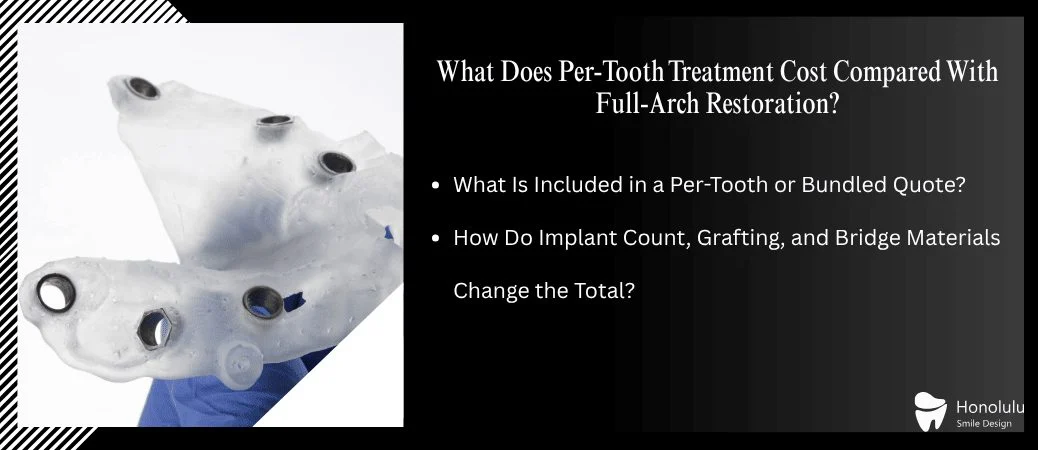
A per-tooth quote usually covers the implant post, the abutment (the small connector piece between implant and crown), and the crown itself. Extractions, bone grafting, CT scans, and sedation are often billed separately.
A bundled All-on-4 quote typically wraps extractions, implant placement, and a same-day temporary bridge into one fee, with the final zirconia or acrylic bridge billed separately after healing.
Ask your implant dentist for a written, itemized plan either way. A detailed look at dental implant cost factors can help you compare line items before you commit.
How Do Implant Count, Grafting, and Bridge Materials Change the Total?
Implant count is the biggest lever. Six-implant arch solutions average $12,474 per arch, compared to $15,176 for All-on-4, largely because All-on-4 uses fewer implants and grafting less often.
Bridge material matters too. A zirconia final bridge costs more than acrylic, and grafting procedures, when needed, add separate fees and extra healing time before implants go in.
How Does Jawbone Health Affect the Choice?
Jawbone density and the location of bone loss often decide which plan is realistic before cost or appearance even enter the conversation.
At Honolulu Smile Design, Dr. John Ha, DDS draws on his training in dental implantology and advanced bone grafting to evaluate bone support and discuss suitable implant treatment options.
When Can Angled Implants Reduce the Need for Grafting?
Angled implants can often reduce or remove the need for bone grafting by anchoring into bone that is still dense, even when the bone directly under a missing tooth has thinned.
The upper jaw tends to have softer bone and sits close to the sinus cavities, so tilting the back implants forward, toward sturdier bone near the front, lets All-on-4 frequently avoid a sinus lift procedure.
The lower jaw is denser overall and tends to integrate with implants faster.
When Might a Different Implant Plan Be Safer?
A different implant plan is safer when bone loss is severe enough, or located in a spot, where even angled implants cannot find a secure anchor.
In those cases, your surgeon might recommend grafting first, a six or eight-implant bridge for more support, or zygomatic implants anchored in the cheekbone for severe upper-jaw bone loss.
If you are facing this situation, a page on zygomatic dental implants explains how that option works for cases where standard implants are not viable.
Bone grafting itself typically needs three to six months to mature before implants can be placed, which is worth factoring into your timeline either way.
What Will Treatment and Daily Care Involve?
Treatment timelines and daily upkeep differ noticeably between the two approaches, and both involve a healing period called osseointegration, where bone fuses to the titanium implant.
All-on-4 often delivers “teeth in a day,” while individual implants generally mean a longer wait before your final crowns go on.
Are Same-Day Teeth the Final Teeth?

Same-day teeth are not your final teeth. They are a temporary fixed bridge placed the day of surgery, worn while the implants heal and fuse to the bone over several months before the permanent bridge is attached.
Same-day loading also depends on the implants achieving enough stability at placement, and not every patient qualifies for it, a point stated by a systematic review of the All-on-4 treatment concept showing survival rates above 99% across the studies reviewed, alongside a note that follow-up data has real limits.
How Do Healing and Cleaning Differ?
Healing for All-on-4 generally runs three to six months before the final bridge is fitted, while individual implants often take six to twelve months total, longer if grafting comes first.
Daily cleaning differs too: an All-on-4 bridge needs a water flosser to clean underneath it and usually comes off once a year for a professional cleaning, while individual implant crowns are brushed and flossed like natural teeth.
Good oral hygiene matters for both, since healthy gums around implants protect your long-term oral health either way.
When Does a Mixed Approach or a Third Option Make Sense?
A mixed approach makes sense when your upper and lower arches are in different conditions, or when some of your natural teeth are still healthy enough to keep.
One arch might qualify for All-on-4, while the other, with more remaining healthy teeth, may be better served by individual implants or a traditional implant bridge.
Removable implant-supported dentures are another option worth considering. They offer more stability than traditional dentures and may cost less than fixed implant restorations.
Understanding the differences between All-on-4 and implant-supported dentures can help you evaluate comfort, maintenance, and long-term needs.
Choose the Plan That Fits Each Arch

Full-arch tooth replacement comes down to the condition of your jawbone, how many of your own teeth are worth saving, and how you want to care for your new teeth long-term.
All-on-4 offers a fixed bridge on four implants with a shorter timeline and often no grafting, while individual implants cost more across a full arch but keep each tooth independent and your bone architecture closer to its natural state.
Neither path is right for every mouth, and your upper and lower arches might not need the same plan.
A written treatment plan from your implant dentist, built around your own bone scan, is the only way to know which dental implants fit your case.
Frequently Asked Questions
Is All-on-4 suitable for both the upper and lower jaw?
Yes, All-on-4 is used in both the upper jaw (maxilla) and lower jaw (mandible), though the bone in each differs. The upper jaw has softer bone and sits near the sinus cavities, while the lower jaw is denser and tends to heal faster.
Can I keep healthy teeth instead of replacing the entire arch?
Often, yes, if enough of your natural teeth are structurally sound and free of advanced decay or gum disease.
All-on-4 requires removing all remaining teeth in that arch, so if you want to keep healthy teeth, individual implants or a mixed treatment plan are worth discussing with your implant dentist.
Does a full arch of individual crowns need one implant per tooth?
Not usually. Most full-arch plans that avoid All-on-4 use a traditional implant bridge supported by 6 to 8 implants rather than a separate implant under all 10 to 14 teeth, which keeps costs and surgical complexity more manageable.
Can I get All-on-4 if I have significant bone loss?
Often, yes, because the angled back implants are designed to reach denser bone and work around areas of bone loss.
Severe bone loss in certain spots may still call for grafting, a different implant count, or zygomatic implants anchored in the cheekbone instead.
Could I use different implant options for my upper and lower arches?
Yes, and this is common when one arch has more remaining bone or healthy teeth than the other.
You might get All-on-4 on one jaw and individual implants, a traditional implant bridge, or implant-supported dentures on the other, based on what each arch’s bone and teeth can support.