When a tooth hurts badly enough to keep you up at night, the question on your mind is simple: can this tooth be saved, or does it have to go?
Your dentist is asking a slightly different question, and it’s the one that determines everything that follows. Is enough healthy tooth left to rebuild, and will that rebuilt tooth hold up for years under normal chewing?
A toothache with an infected or dead pulp (the soft nerve tissue inside the tooth) does not automatically mean removal. It means the inside of the tooth needs treatment.
When comparing root canal vs tooth extraction, the right choice comes down to what a dental exam and radiographs (X-rays) show about the tooth structure, roots, infection, and supporting bone.
A tooth that still has solid walls, stable roots, and healthy bone support around it is a good candidate for a root canal and crown; a tooth with a vertical root fracture, decay running deep below the gum, or severe bone loss from gum disease is where extraction becomes the more predictable path.
That distinction is worth sitting with before you say yes to anything.
Deciding between a root canal or extraction shapes your bite, your bone, and your dental spending for the next decade, so it deserves more than a rushed yes in the chair.
Key Takeaways
- A tooth is saved when enough healthy structure, stable roots, and solid bone remain to support a lasting restoration.
- Root canal treatment may require a crown afterward, while extraction may require tooth replacement depending on the tooth and your bite, so compare the complete treatment pathway.
- Extraction costs less on day one, but replacing the tooth with an implant often pushes the total well past a root canal and crown.
Table of Content
- What Determines Whether a Tooth Can Be Saved?
- What Does Each Treatment Involve?
- When Extraction and Tooth Replacement Make More Sense
- How Do Recovery, Cost, and Future Care Compare?
- Choose the Option With the Strongest Long-Term Prognosis
- Frequently Asked Questions
What Determines Whether a Tooth Can Be Saved?
Four findings drive the decision: how much solid tooth is left, whether the roots and their attachment to bone are intact, whether infection and cracks can be cleaned out and sealed, and what job that tooth does in your bite.
Dentists weigh these together to estimate long-term prognosis, and no single one of them decides the case alone.
At Honolulu Smile Design, our dental team evaluates the condition of the tooth, roots, surrounding bone, and overall oral health before recommending whether preserving or removing the tooth may offer the more predictable outcome.
Is There Enough Healthy Tooth Structure for a Lasting Restoration?
Your dentist is looking for enough natural tooth structure above the gum line to grip a crown.
Enamel and dentin form the walls that hold everything together, and when decay eats through those walls down past the bone level, there is nothing solid left to bond to.
A useful rule of thumb from clinical practice: if at least a couple of millimeters of firm tooth wall circles the tooth above the bone (the “ferrule”), a crown has something to hug. Below that, the restoration tends to loosen or the tooth splits under chewing force.
Deep decay does not automatically end the discussion. Crown lengthening or a post can sometimes buy back enough structure, and your dentist should explain whether that applies to your tooth.
Are the Roots and Periodontal Attachment Stable?
The roots need to be surrounded by healthy bone and an intact periodontal ligament, the thin cushion of fibers that anchors each root.
Radiographs show how much supporting bone is left, and gentle probing around the tooth shows how deep the pockets go.
A tooth with mild mobility from an active infection often tightens back up after treatment.
A tooth that wiggles because periodontal disease has eaten away half its bone support will not, and a root canal does nothing to rebuild that bone.
Advanced gum disease around a single tooth changes the plan. Sometimes gum disease treatment comes first, and the extraction decision waits until the tissue responds.
How Do Fractures, Decay, and Infection Change the Prognosis?
A vertical root fracture is the finding that most often closes the door on saving a tooth. The crack runs lengthwise down the root, bacteria live inside the split, and no filling material seals it.
Extraction is the honest recommendation when that crack is confirmed.
A cracked tooth that stops at the crown is a different story. Those teeth are frequently treated with a root canal and a crown that holds the segments together.
Infection alone, even with swelling and an abscess visible on the X-ray, rarely dooms a tooth.
Removing the infected pulp and sealing the canals is exactly what root canal treatment is designed to do, and dentists consistently point to whether the infection can be fully cleared.
Why Does the Tooth’s Role in Your Bite Matter?
A first molar carries a heavy share of your chewing load, and losing one shifts force onto neighboring teeth. Saving a molar keeps your bite stable and keeps the opposing tooth from drifting down into the empty space.
Wisdom teeth sit at the other end of the scale. An impacted or hard-to-clean third molar is often removed without any replacement, because it contributes little to chewing function.
Your dentist should also look at the teeth on either side. When those neighbors already need crowns, the calculation about saving the middle tooth can change.
What Does Each Treatment Involve?
Root canal treatment cleans out the inside of the tooth and leaves the roots in your jaw; extraction removes the whole tooth, roots included.
Both are done under local anesthesia, and both have a follow-up step that patients frequently underestimate.
How Root Canal Treatment Removes Infection and Preserves the Tooth
Endodontic treatment starts with numbing, then a small opening through the top of the tooth.
Your dentist cleans the infected or dead pulp out of the root canals, shapes and disinfects them, then fills the space with gutta-percha, a rubbery sealing material.
The tooth stays in your jaw. Its roots keep stimulating the bone, and the periodontal ligament keeps doing its job.
Most people describe the appointment as similar to getting a large filling. The pain that brought you in is usually gone within a day or two, because the inflamed nerve tissue is gone.
Why a Root Canal Plus Crown Is Often Needed
A crown is commonly recommended after root canal treatment on a back tooth because the remaining tooth structure may be more vulnerable to fracture.
Your dentist will determine the appropriate restoration based on how much healthy tooth structure remains.
Think of the crown as the structural half of the treatment. The root canal handles the infection; the crown handles the load.
Budget for both from the start. Quotes that mention only the root canal fee leave out a real cost you will face within a few weeks.
What Happens During a Simple or Surgical Extraction
A simple extraction loosens the tooth with an instrument and lifts it out through the socket, usually in a few minutes once you are numb.
A surgical extraction involves a small gum incision, and sometimes the tooth is sectioned into pieces or a little bone is removed around it.
Broken-down, curved-rooted, or impacted teeth typically require the surgical approach. Recovery involves more swelling and a longer soft-food stretch.
Your dentist may also discuss placing a bone graft into the socket at the same visit if an implant is in your future plans.
Can a Failed Root Canal Still Be Treated?
A root canal that fails months or years later often has two rescue options before extraction. Retreatment reopens the tooth, removes the old filling material, and re-cleans canals that may have been missed or reinfected.
An apicoectomy is the second option: a small procedure that removes the very tip of the root and seals it from the outside.
Both are usually handled by an endodontist, a dentist with extra training in root canals.
Ask whether either has been considered before agreeing that a previously treated tooth is hopeless.
When Extraction and Tooth Replacement Make More Sense
Extraction becomes the better plan when the tooth cannot be predictably restored, and the decision then expands into how you will fill the space.
A missing tooth left alone lets neighbors tip and the opposing tooth drift, which is why replacement is part of the conversation from the beginning.
When Is Extraction the More Predictable Choice?
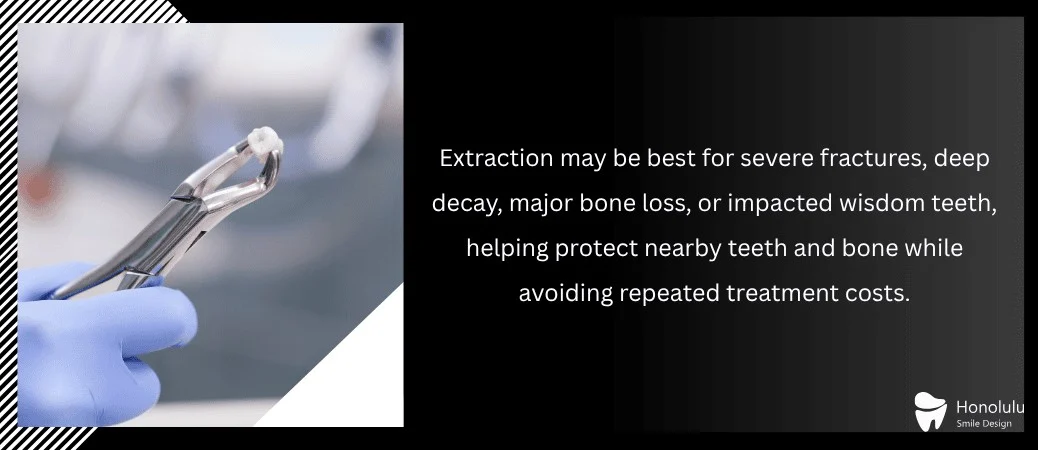
Removal is the stronger call when a vertical root fracture is confirmed, when decay runs so far below the gum that no crown margin can be reached, or when severe periodontal bone loss has left the tooth loose.
Impacted wisdom teeth belong in this group too.
There is also a resource question that dentists take seriously. Pouring money into a tooth with a guarded prognosis can leave you paying twice when it fails a year later.
Extraction is a reasonable choice, not a failure. Sometimes it is the move that protects the neighboring teeth and the bone around them.
Do You Need to Replace a Missing Tooth?
Most back teeth should be replaced, because tooth loss in the chewing zone changes how force spreads across your jaw.
Teeth drift into the gap over months, the opposing tooth grows longer into the space, and the jawbone under the empty socket slowly shrinks.
Wisdom teeth are the clear exception and need no replacement. A lower front tooth in a crowded arch is occasionally left alone as well, depending on your bite.
Your dentist can walk you through replacement tooth options at the same visit where extraction is planned, which is the right time to ask.
How Do Implants, Bridges, and Partial Dentures Compare?
A dental implant is a titanium post placed in the jawbone, topped with an abutment and a crown. A fixed bridge spans the gap by crowning the teeth on both sides.
A removable partial denture clips onto remaining teeth and comes out for cleaning.
| Root canal + crown | Implant | Fixed bridge | Partial denture | |
| Keeps your natural tooth | Yes | No | No | No |
| Preserves bone at the site | Yes | Yes | No | No |
| Alters neighboring teeth | No | No | Yes | Minimal |
| Typical US cost | $1,500-$3,000 | $3,000-$6,000 added to extraction | Varies by span | Lowest |
| Total timeline | Weeks | Months | Weeks | Weeks |
If you are weighing fixed versus removable, the comparison of dental implants vs traditional bridges covers how each affects the teeth around the gap, and there’s a separate look at tooth implant vs dentures for anyone considering the removable route.
When Might Bone Grafting Be Part of the Plan?
A bone graft is often placed right after extraction to preserve the socket for a future implant. Without it, the ridge narrows during bone healing, and the site may not hold an implant later without a second surgery.
Grafting at the time of removal costs less than rebuilding the ridge months down the road. Ask about it before the extraction, not after.
If implants are on your radar, the practical details in this overview of dental implant cost factors explain what drives the final number.

How Do Recovery, Cost, and Future Care Compare?
Root canal recovery is milder and shorter than extraction recovery for most people, and the cost picture reverses depending on whether you count day one or year five.
Root canal recovery is often shorter than extraction recovery, while overall costs depend on the complete treatment plan, including any restoration or tooth replacement that may be needed.
Is Root Canal Recovery Easier Than Extraction Recovery?
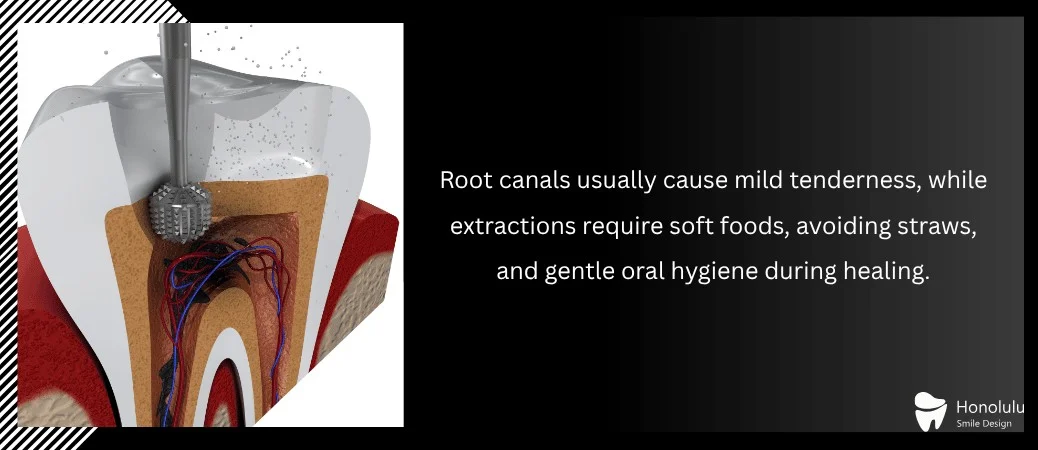
Yes, in most cases. After a root canal, the tooth may feel tender to bite on for a few days, and over-the-counter pain relievers handle it. You can eat normally on the other side that same day.
Extraction leaves an open socket that needs a clot to form and stay put. Expect soft foods for several days, no straws, and swelling that peaks around day two or three after a surgical removal.
Keep brushing gently everywhere else during healing. Steady oral hygiene habits protect the site and the teeth around it.
What Affects the Cost of Root Canal vs Tooth Extraction?
Extraction may have a lower initial cost than saving a tooth with root canal treatment and a crown. However, the comparison changes if the extracted tooth needs to be replaced with a dental implant, bridge, or partial denture.
At Honolulu Smile Design, Dr. John Ha, DDS can explain what each option involves and which additional procedures may be needed based on the condition of your tooth and overall oral health.
How Can Financing Help With Treatment Costs?
Treatment costs can vary depending on whether you need a root canal and crown, an extraction, or tooth replacement afterward.
If paying for treatment at once is difficult, Honolulu Smile Design offers dental care financing options that may help make treatment costs more manageable.
When Is a Second Opinion Worth Seeking?
Get one whenever a tooth is scheduled for removal and you have not heard a clear reason why it cannot be saved. Endodontists see borderline teeth all day and sometimes restore what a general dentist would remove.
A second opinion is also reasonable when the plan involves multiple teeth or several thousand dollars. Bring your radiographs so you are not paying for new images.
Good questions to carry in: How much solid tooth is left above the bone? Is there a confirmed root fracture? What is the estimated long-term prognosis if we save it?
Choose the Option With the Strongest Long-Term Prognosis

Saving the natural tooth may be preferred when the exam shows enough healthy tooth structure to hold a crown, roots surrounded by solid bone support, and infection that can be cleaned out and sealed.
Those conditions make a root canal and crown a durable, bite-stable result that keeps your jawbone stimulated.
Extraction may be more appropriate when a vertical root fracture is confirmed, when decay has run too deep to restore, or when periodontal bone loss has already loosened the tooth.
In those cases, removing it and planning a tooth replacement gives you a more predictable outcome than fighting for a tooth that will not hold.
Bring your specific questions to the exam: what the radiographs show, how much tooth remains above the bone, and what each full pathway will cost from start to finish.
Frequently Asked Questions
Is a root canal better than extraction?
A root canal is the better choice when the tooth is restorable, because it keeps your natural tooth, your bite alignment, and the bone around the roots.
Extraction becomes the stronger option when the tooth cannot be predictably rebuilt. Your dentist decides based on remaining structure, bone support, and whether the infection can be fully cleared.
Can a tooth with a cracked root be saved with a root canal?
A confirmed vertical root fracture cannot be saved with root canal therapy, because the crack runs down the root and cannot be sealed.
Cracks limited to the crown are a different situation and are often treated successfully with a root canal plus crown. Your dentist may need to look under magnification or lift a small flap of gum tissue to tell the two apart.
How do dentists know whether there is enough tooth structure to save a tooth?
They measure how much firm tooth wall remains above the bone level and check whether a crown can grip at least a couple of millimeters of it.
Radiographs show how far decay extends below the gum. When the margin sits too deep, crown lengthening is sometimes an option before extraction is considered.
Is extraction cheaper than a root canal and crown?
Extraction alone generally has a lower upfront cost than root canal treatment followed by a restoration.
However, if the missing tooth needs to be replaced with a dental implant, bridge, or partial denture, the overall cost comparison can change.
Compare the complete treatment plans rather than the cost of individual procedures.
Should I see an endodontist before agreeing to an extraction?
Yes, especially if the tooth is a molar, if the plan follows a previous root canal, or if no clear structural reason for removal has been explained to you.
An endodontist has extra training in saving compromised teeth and can offer retreatment or an apicoectomy. Bring your existing radiographs to the consultation.