Zygomatic implants after failed bone graft treatment may offer another route to fixed upper teeth by anchoring implants in the cheekbone rather than relying entirely on the weakened upper jaw ridge.
Whether that path fits you depends on why the graft failed, whether any infection has cleared, how healthy your sinuses are, and what bone remains.
Hearing that a graft did not take can feel like a door closing, especially after months of healing.
Many people with severe upper jaw bone loss have dense bone left in the cheekbone even when the ridge above their gums has thinned a great deal. That bone is what zygomatic dental implants are designed to use.
Your next step is a careful reassessment. With it, you can weigh fixed teeth with zygomatic implants against a repeat bone graft or a mixed plan, and you can ask better questions at your consultation.
Key Takeaways
- A failed graft changes your plan but leaves fixed teeth on the table for many people.
- Infection, sinus health, and the reason for failure must be checked before any new surgery.
- High implant survival still comes with real complication risks that need lifelong follow-up.
Why a Failed Graft Does Not Automatically Rule Out Fixed Teeth
Fixed teeth stay possible after graft failure because a zygomatic implant draws its support from a different bone than the one the graft tried to rebuild.
Conventional implants need enough height and width in the jaw ridge. A zygomatic implant reaches past that ridge into the zygoma, your cheekbone.
How Does Cheekbone Anchorage Differ from a Rebuilt Jaw Ridge?
Bone grafting tries to add volume back to a shrunken ridge so standard dental implants have room to sit. That rebuilt bone has to heal, mature, and hold its shape. When it resorbs or gets infected, the implant site loses its foundation.
Zygomatic implants work around that problem. They are long titanium posts, roughly 30 to 52.5 mm in length, that start in the upper jaw and angle up into the cheekbone.
The cheekbone holds its shape well even after years of jaw bone loss.
Here is how the two foundations compare:
| Feature | Rebuilt jaw ridge (graft) | Cheekbone anchorage (zygomatic) |
| Bone source | Added graft material | Your own existing cheekbone |
| Healing before implants | Months | Implants placed in existing bone |
| Affected by graft failure | Yes, directly | Less dependent on the failed site |
| Surgical complexity | Moderate to high | High, specialist-level |
Zygomatic surgery is a bigger, more technical operation. It trades graft healing time for advanced planning and surgical skill.
What Can Graft Failure Reveal About the Next Treatment?
Your failed graft gives your next surgeon useful clues. A graft can fail because the wound opened, the material became exposed, infection set in, or the bone simply resorbed over time. Each cause points to a different next step.
Some causes stay local to the graft site, such as a wound that opened under too much tension. Others reflect wider issues, like smoking, uncontrolled diabetes, or medications that slow bone healing.
A failed graft can complicate future implant planning, particularly if infection, inadequate bone healing, or underlying health factors contributed to the problem.
Zygomatic implants may offer an alternative because they anchor in the cheekbone rather than relying primarily on the previously grafted ridge.
That finding is one reason zygomatic implants appeal after failure. They anchor away from the damaged ridge.
What Must Be Checked Before Another Implant Procedure?
Before any new surgery, your team needs a clear 3D picture of your bone and sinuses, proof that infection is gone, and a full review of your health. These checks protect you from repeating the same setback.

What Do Previous Treatment Records and a CBCT Scan Show?
Bring every record you can get: operative notes, graft material used, dates, and old X-rays or scans. These tell your new surgeon what was tried and how your body responded.
At Honolulu Smile Design, Dr. John Ha, DDS can review your previous treatment records and imaging to help determine whether another implant approach or a specialist evaluation may be appropriate.
A CBCT scan (cone beam CT) is the key imaging tool. It builds a 3D model of your jaw, cheekbone, and maxillary sinus, and your surgeon can measure bone to the millimeter.
Unlike a panoramic X-ray, a CBCT scan provides detailed three-dimensional views of the cheekbone, surrounding anatomy, and potential implant pathways, helping the surgical team plan placement more precisely.
On a CBCT, your team checks:
- Remaining ridge height and width
- Cheekbone volume and density on each side
- The shape and health of the maxillary sinus
- Leftover graft particles or areas of poor healing
- Nerve and eye socket positions
In maxillary atrophy, the scan sometimes shows a thin front ridge with solid cheekbone behind it, which opens options a 2D film missed.
Does Infection or Sinus Disease Need Treatment First?
Yes. Active infection or sinus disease needs to be controlled before new implants go in. Zygomatic implants pass near or through the maxillary sinus, so a sinus that is already inflamed raises the risk of problems later.
If your graft involved a sinus lift that failed, the sinus lining may be thickened or the sinus may hold leftover material.
Chronic sinusitis can call for a review with an ear, nose, and throat doctor, medication, or a sinus procedure first.
One published case describes a staged approach to a failed zygomatic implant with refractory sinusitis, treating the infection before rebuilding support.
Gum health counts too. Treating gum disease before dental implants lowers the chance that bacteria threaten new implants.
How Do Health, Smoking, and Bridge Design Affect Candidacy?
Your general health affects how well bone heals around any implant. Smoking, poorly controlled diabetes, certain bone conditions, and some medications may affect implant treatment planning or healing.
Their risks differ, so your surgical team should review your medical history, medications, and overall health before recommending another procedure.
If you live with diabetes, dental implants for diabetics work best when blood sugar is steady before surgery.
Quitting smoking before and after surgery is one of the most useful changes you can make. Many surgeons ask you to stop weeks ahead.
Bridge design comes into planning early. Your surgeon and restorative dentist plan where the teeth will sit first, then place implants to support them.
Your bite force, lip support, and how much gum shows when you smile all affect implant number and position.
Which Implant Plan Fits the Bone That Remains?
The right plan matches the bone you still have, and options range from repeat grafting to four zygomatic implants.
Moderate bone loss sometimes still allows conventional or tilted implants, while severe maxillary atrophy more often calls for cheekbone support.
When Might Repeat Grafting or Tilted Implants Still Work?
A second graft can make sense when the first one failed for a clear, fixable reason, such as a wound that opened or a denture pressing on the site.
If your health is good and the cause has been corrected, a new sinus lift, block graft, or ridge augmentation could still rebuild enough bone.
Tilted implants are another route. In All-on-4 dental implants, the back implants are angled to avoid the sinus and use longer stretches of native bone.
Angled implants often reduce or avoid grafting when some ridge remains. Comparing All-on-4 with individual implants helps you see how implant count and angle change the plan.
These routes rely on enough native ridge. With severe upper-jaw bone loss, that ridge is usually too thin.
When Can Zygomatic and Conventional Implants Work Together?
A combined plan fits when your front jaw still has decent bone but the back has collapsed toward the sinus.
In this setup, one zygomatic implant on each side supports the back of the bridge, and two to four conventional implants hold the front.
This follows the original design. Research shows that the first protocol paired one implant in each zygoma with two to four front conventional implants. Using your own front bone keeps the surgery smaller than placing four long implants.
When Is Quad-Zygoma Considered for a Full Upper Arch?
Quad-zygoma uses two zygomatic implants per side, four in total. It is considered when both the front and back of the upper jaw lack enough bone for conventional implants, which is common after repeat failures.
The four implants spread chewing forces across the arch without relying on the ridge at all. It is the most demanding version of zygomatic dental implants, so your surgeon’s experience with this exact technique deserves a direct question at consultation.
How Soon Could You Receive a Fixed Upper Bridge?
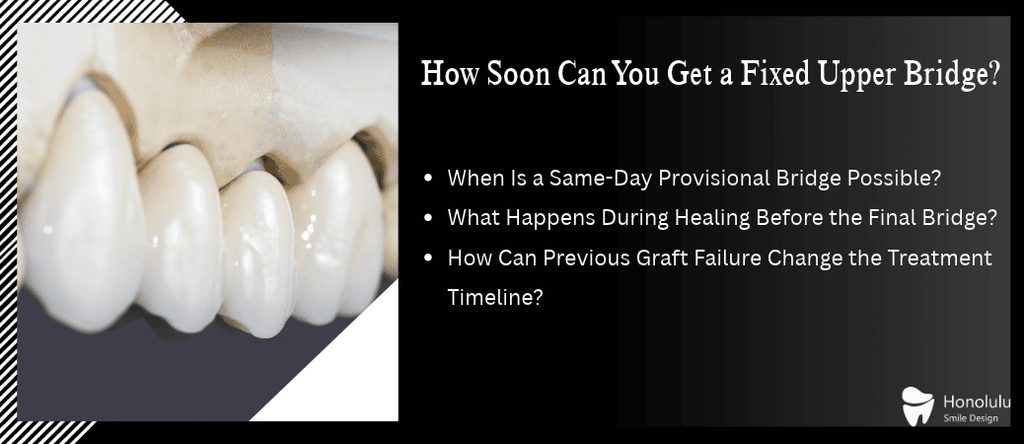
Many zygomatic patients leave surgery with a fixed temporary bridge within days, and the final bridge follows months later. Your exact timing depends on how firmly the implants hold at surgery.
When Is a Same-Day Provisional Bridge Possible?
Immediate loading means attaching teeth soon after implants go in. It works when each implant locks in tightly at surgery, which surgeons measure as primary stability.
Zygomatic implants often reach this because they grip dense cheekbone.
Published studies suggest that immediate loading of zygomatic implants can be a viable option for selected patients with severe upper jawbone loss.
However, the decision depends on implant stability, bone conditions, and the overall treatment plan.
If stability is weak, your surgeon may wait. Same-day teeth are a goal, and a same day tooth implant plan should always include a backup.
What Happens During Healing Before the Final Bridge?
The fixed provisional bridge is lighter and made of softer material. It lets you eat and smile while osseointegration happens, the process where bone bonds to the implant surface.
During these months, expect:
- A soft diet for the first weeks, then gradual firmer foods
- Sinus precautions, such as avoiding forceful nose blowing
- Check-ups to watch the gums, bite, and sinuses
- Possible bridge adjustments as swelling goes down
Once healing is confirmed, your final bridge is made, often from stronger materials like zirconia or a metal-reinforced acrylic.
How Can Previous Graft Failure Change the Treatment Timeline?
A failed graft can add steps at the start. If old graft material is infected or loose, it needs removal and the site needs time to heal first. Sinus treatment, if needed, adds more weeks.
Your health work also takes time. Getting blood sugar controlled or stopping smoking may push surgery back. Ask your team for a written sequence so you know each stage and why it comes before the next.
What Risks and Long-Term Care Should You Understand?
Zygomatic implants have strong long-term survival, yet they carry specific risks, with sinus problems at the top of the list. Knowing them helps you spot trouble early.
Which Surgical, Sinus, and Bridge Complications Are Possible?
Sinusitis is one of the most frequently reported complications of zygomatic implants. It may develop months or years after surgery and can sometimes require additional treatment.
The likelihood varies depending on the surgical approach, existing sinus health, and follow-up period.
Other complications include:
- An opening between the mouth and sinus (oroantral communication)
- Gum breakdown or inflammation around the implant
- Swelling, bruising, and bleeding after surgery
- Rare nerve or eye-area injury
- Bridge screws loosening or teeth chipping
Call your team about facial pressure, a blocked or runny nose on one side, a bad taste, or fluid passing between mouth and nose.
Why Does Implant Survival Not Mean Complication-Free Treatment?
Survival means the implant is still in place. It says nothing about whether you had sinusitis, a repair, or a bridge fix along the way.
An implant can survive while you deal with sinus treatment or gum problems around it. Ask your surgeon about both numbers: how many implants stay in, and how many patients need extra care.
What Specialist Experience and Ongoing Maintenance Should You Expect?
Choose a surgeon who places zygomatic implants regularly and plans with 3D scans. Ask how many cases they have done, how they handle sinus complications, and who manages your bridge long term.
Maintenance follows you for life. Daily cleaning under the bridge with a water flosser or special floss, plus professional cleanings, protects the gums.
These tips for caring for dental implants apply here too. How long your result holds ties closely to that care, and how long dental implants last depends on checkups as much as surgery.
A New Assessment Can Clarify Your Path to Fixed Teeth

A failed bone graft is a setback, and for many people it still leaves a route to fixed teeth. Zygomatic implants use cheekbone support, so they can work where the ridge did not.
Your next move is a full review that covers why the graft failed, a CBCT scan, sinus and gum health, and your medical history.
From there, your team can tell you whether repeat grafting, tilted implants, a combined plan, or quad-zygoma fits your bone.
Before your visit to your dentist, gather your old records, write down your medications, and list your questions about timing, risks, and follow-up care. Bring them to your consultation so your plan starts with complete information.
Frequently Asked Questions
Does a failed sinus lift rule out zygomatic implants?
No, a failed sinus lift does not rule them out. Your sinus needs to be healthy and free of infection first, and a CBCT scan will show leftover material or a thickened lining that needs care.
Will the old graft material need to be removed?
Only if it is infected, loose, or blocking the implant path. Stable, healed material can sometimes stay, and your surgeon decides this from your exam and scan.
How long should I wait after graft failure before another procedure?
The waiting period depends on why the graft failed, whether infection is present, and how well the surrounding tissues heal.
Some patients may need additional healing time or sinus treatment before another implant procedure. Your surgeon will recommend the appropriate timeline after examining the site.
Can I get a full upper arch without another bone graft?
Yes, many people can. Zygomatic implants, alone or with conventional implants, are designed to support a full arch without bone grafting when the cheekbone has enough volume.
What affects the cost of zygomatic treatment after a failed graft?
Cost depends on how many zygomatic and conventional implants you need, extra steps like graft removal or sinus treatment, sedation, and bridge material. These dental implant cost factors shape your quote, so ask for an itemized plan.